
By Francis J. Waller
Have you, as a stamp collector, seen your stamps in a different light? Ultraviolet (UV) light that is! Not to detect stamp forgeries or alterations but to detect tagging. Tagging of stamps came about when worldwide postal administrations, which cancelled large volumes of stamped mail, began to use modern, high-speed, mechanical processing of mail. Tagged stamps helped to automatically position the envelope and cancel the stamp without any manual handling.
This then brings us to the study of luminescence and stamps or stamps that “glow.” Luminescence simply means giving off light, and it comes in a few forms: phosphorescence, fluorescence, and chemiluminescence. Both phosphorescence and fluorescence require an external light source to trigger the glow. Chemiluminescence is different, and probably more familiar than you think, it’s the same process behind fireflies lighting up on a warm summer night, where the “glow” comes from a chemical reaction rather than any external light
Phosphorescent tagging is the king that linkers; stamps treated with a phosphorescent material continue to “glow” a short time after the light source is shut off. The trigger here is short-wave UV light, at 254nm. Two phosphorescent compounds were used in the beginning of tagging U.S. stamps: zinc orthosilicate (emits greenish-yellow light) and calcium silicate (emits orange-red light). Stamps can also be fluorescent, that is, emit light when exposed to long-wave UV light, at 365nm, but stops the instant after the lamp is shut off..
Tagging can occur in many ways. The paper itself can contain the luminescent material therefore both sides of the stamp would give off light or be coated with the material on one side. The material can also be mixed with the printing ink. Tagging styles exist, that is, emitting light can appear as border around the perimeter of the stamp, as two vertical bars one on each side of the stamp, or other configurations.
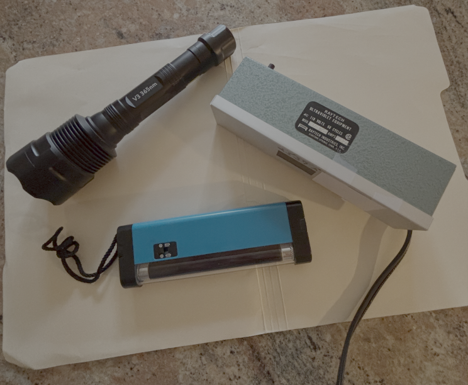
The only real difference between tagged and non-tagged versions of the same stamp is invisible until you introduce UV light of the correct wavelength; then a tagged stamp will “glow” while the untagged one won’t. The wavelength of UV light is produced by a portable UV light source. More on that later. Photo # 7 shows some handheld devices.
Compare Photo #1 and Photo #2 to see tagging in action. In Photo #1, the German stamps appear under natural light, front and back. In Photo #2, those same stamps take on a yellowish glow, also front and back; that’s because the paper itself is tagged with a fluorescent material, responding to long-wave UV light at 365nm.
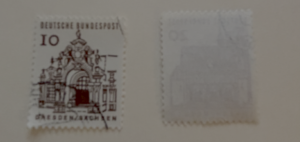
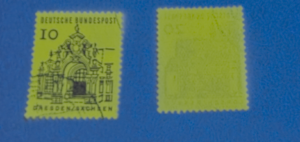
Photo #3 shows two different U.S. stamps under normal light; Photo #4 shows those same stamps under short-wave UV light, 254nm. This is the wavelength that makes U.S. stamps “glow.” Early on, the postal service used tagging compounds that gave off an orange-red glow; that lasted only a few years, and most tagged U.S. stamps today glow greenish instead.
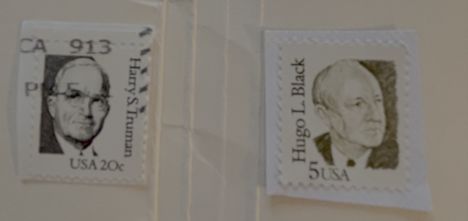
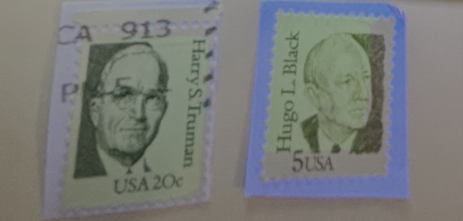
Photo #5 shows examples of Canadian stamps under normal light; Photo #6 shows the same stamps under long-wave UV light, 365nm. Notice the yellowish-green luminescence that appears
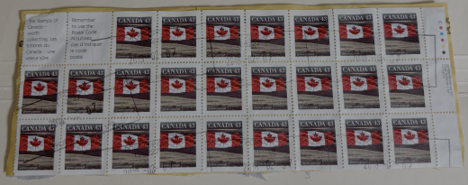
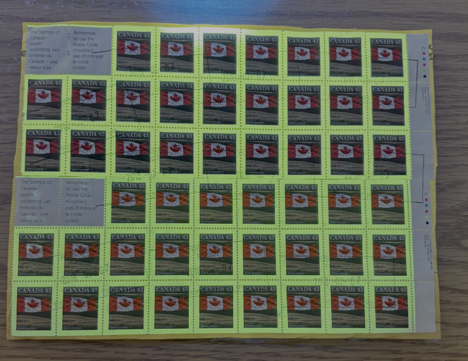
Many materials luminesce under UV light, and different emission colors show up in stamp and paper tagging worldwide; examples include Germany, Switzerland, Denmark, Great Britain, Japan, Italy, China, France, Finland, and Australia. In the U.S., cancelling inks themselves sometimes contained luminescent material, so the wavy-line machine cancel would “glow.” This was mainly seen between 1980 and 1987.
Photo #7 shows examples of UV light sources. The flashlight produces 365nm light, as does the small Lighthouse device. The third device gives off both short wave (254nm) and long wave (365nm) light; it’s the LS-2, made by Raytech. To use it for 254nm light only, the window that transmits long wave light is covered with an index card.
Electromagnetic radiation includes the region of wavelengths between 10nm to 10,000nm. This part of the spectrum of light contains wavelengths of 254nm (short wavelength) and 365nm (long wavelength). Remember within this region is also the visible light between 420nm to 700nm and 1,000 to 10,000nm light or infrared.
Some facts about U.S. and Canadian stamps that glow:
- First U.S. tagged stamp were released to the public in August 1963 had phosphorescent ink applied to its surface and “glowed” orange-red. This was the 8-cent Jet & Capitol airmail stamp [C64b]. Tagging became a practice in 1973. U.S. stamps require short wavelength (254nm) UV light.
- In 1987, U.S. tested luminescence paper to test the feasibility of printing stamps on phosphor-coated paper [Scott 2115b].
- First five Canadian stamps of the Queen Elizabeth II- Wilding Portrait (1, 2, 3, 4, 5-cents) were released on January 13, 1962 with a blue phosphorescent coating [337p-341p]. The blue color was hard to see or detect.
- In 1971, Canada introduced new luminescent coating that was fluorescent not phosphorescent. The coating emitted greenish-yellow light when exposed to long wavelength light (365nm).
Beware: Best to examine your “glow” stamps on paper or mint. When soaking stamps from paper, some types of soaps or cleaners have luminescent qualities and transfer to the stamp.
CAUTION: The user of UV light devices should never look at the light source when it is on. Many people wear glasses and this helps to prevent any stray light from entering your eyes. Exposure to UV light will damage your eyes. If you go to the beach and it is a sunny day, you may develop a red glow on your skin if you stay in the sun to long and not wearing sunscreen. Pretend your skin is your eyes. Same effect.